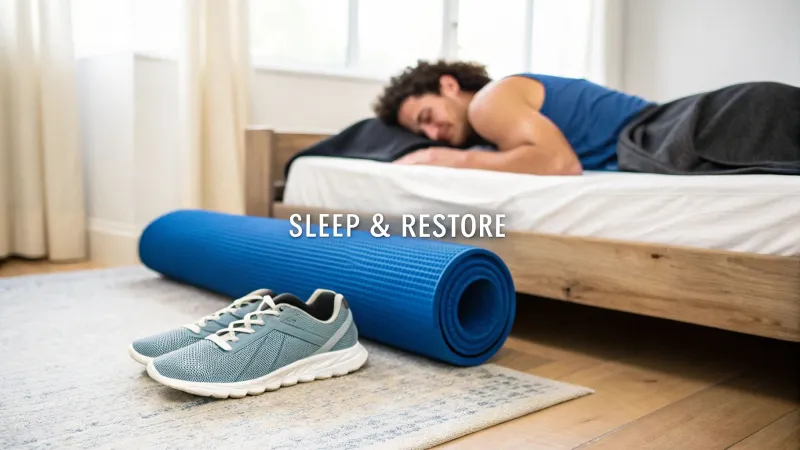
Lights Out Before Bottles Out: The Overnight Hormone Shift No Booster Can Replace
Photo: Internet Archive Book Images, No restrictions, via Wikimedia Commons
Here's a question we get a lot at Everest Steroids: "Which booster should I add to my stack next?"
Nine times out of ten, the honest answer isn't a product. It's a pillow.
Think about how summit expeditions work. Climbers don't scrimp on oxygen tanks to afford fancier boots. Oxygen is non-negotiable — everything else is optional gear. Sleep occupies that same spot in your hormone economy. It's the base layer every bottle in your cabinet sits on top of, and when it's thin, nothing above it holds up.
What Actually Happens While You're Out Cold
Most of your testosterone isn't made during the day — it's manufactured overnight. Your hypothalamus kicks off a cascade during deep sleep, signaling the pituitary to release luteinizing hormone, which then tells the testes to get to work. The bulk of daily testosterone production rides on those first few cycles of slow-wave sleep.
Miss them, and you're not just tired. You're literally skipping the factory shift.
The research backs this up. Studies on sleep restriction — think five hours a night for a week — have shown measurable drops in daytime testosterone in healthy young men, with some trials showing reductions of 10-15%. Cortisol, meanwhile, climbs. That's the worst possible trade: less of the anabolic hormone you want, more of the catabolic one you don't.
And here's the kicker for anyone running a booster: most legal test boosters on the US market — the ashwagandha, zinc, magnesium, fenugreek crowd — work by supporting the conditions for hormone production. They're not injections. If your body is running on four hours of broken sleep, there's not much raw material for them to work with.
The Late-Night American Problem
Let's be real about how most of us live. Lights off at midnight after a final scroll through Instagram. Alarm at 5:45 for the gym before work. A second wind around 9 PM fueled by a post-dinner espresso or a pre-workout taken too late.
That routine is a hormone tax. And it's one a $60 bottle can't pay down.
Alcohol deserves its own callout, too. A few beers might knock you out faster, but alcohol fragments the second half of the night and suppresses REM and slow-wave sleep. That "I sleep fine after a couple drinks" feeling is your perception lying to you.
Run the Free Sleep Audit
Before you add anything to your cart, spend seven days scoring yourself on these:
- Lights-out consistency: Are you in bed within the same 30-minute window every night, weekends included?
- Total time in bed: Is it 7.5 hours or more? If not, no supplement fixes that math.
- Screen cutoff: Do you have at least 30 screen-free minutes before bed?
- Caffeine cutoff: Is your last coffee or pre-workout 8+ hours before sleep?
- Room conditions: Dark, cool (around 65-68°F), and quiet?
- Alcohol: Fewer than four nights a week, and never within three hours of bed?
- Wake-ups: Do you sleep through the night, or are you up at 3 AM staring at the ceiling?
Score honestly. If you're failing three or more, you've found your bottleneck — and fixing it costs nothing.
The Smart Budget Stack, Starting at $0
Here's how we'd sequence your spending if money matters (and it always does):
- $0 — Sleep hygiene. Consistent schedule, dark room, caffeine discipline. This is the foundation, and it's free.
- $10-20 — Magnesium glycinate and possibly melatonin for occasional jet-lag-style resets. Cheap, well-tolerated, and they support the sleep that supports your hormones.
- $30-60 — A legit test booster. Only once steps one and two are locked in. Now the ingredients actually have something to work with.
- Everything else. Protein, creatine, whatever your goals call for — built on top of a body that actually recovers.
Most guys do this backwards. They buy the bottle first, wonder why nothing's happening, then blame the product. The product was fine. The foundation wasn't.
The Bottom Line
No supplement on any American shelf outperforms a good night's sleep for hormone support. Nothing close. If your training's stalled, your libido's flat, and your booster seems like a dud, audit your nights before you audit the label.
Fix the oxygen first. Then climb.